
Fairfield Criminal Court Records
A Fairfield criminal court record begins when a criminal or motor vehicle prosecution is filed in Connecticut Superior Court. The record is not kept by a county clerk because Connecticut does not operate county trial courts for Fairfield. The case file belongs to the court of record, most often a Bridgeport court location for Fairfield-area criminal matters.
Lower-level criminal and many motor vehicle matters commonly use GA 2 at Bridgeport. Serious Part A cases are tied to the Bridgeport/Fairfield Judicial District, where the State's Attorney handles major prosecutions. A criminal court record is broader than a charge list. It follows the case through arraignment, bond, motions, pleas, trial events, disposition, sentence, probation, and post-judgment activity. For the narrower arrest-to-charge path, use the arrest records and charges page.
Search Fairfield Criminal Cases
The Connecticut Judicial Branch Criminal/Motor Vehicle Case Look-up menu is the official online starting point. It separates pending cases, convictions, daily dockets, docket-number searches, arrest warrants, sentence review, and motions to seal or close. That separation is useful because a pending case search answers a different question than a conviction search.
- Open the Criminal/Motor Vehicle Case Look-up menu.
- Choose pending case by defendant when the case may still be open.
- Choose conviction search when the question is whether a public conviction appears.
- Use Bridgeport Geographical Area 2 or Bridgeport Judicial District when a court-location filter applies.
- Record the docket number, court location, charge status, and disposition, then ask the clerk for certified copies when needed.
The pending defendant search is a core source for Fairfield criminal court records. The assigned image below comes from the pending criminal and motor vehicle defendant search.
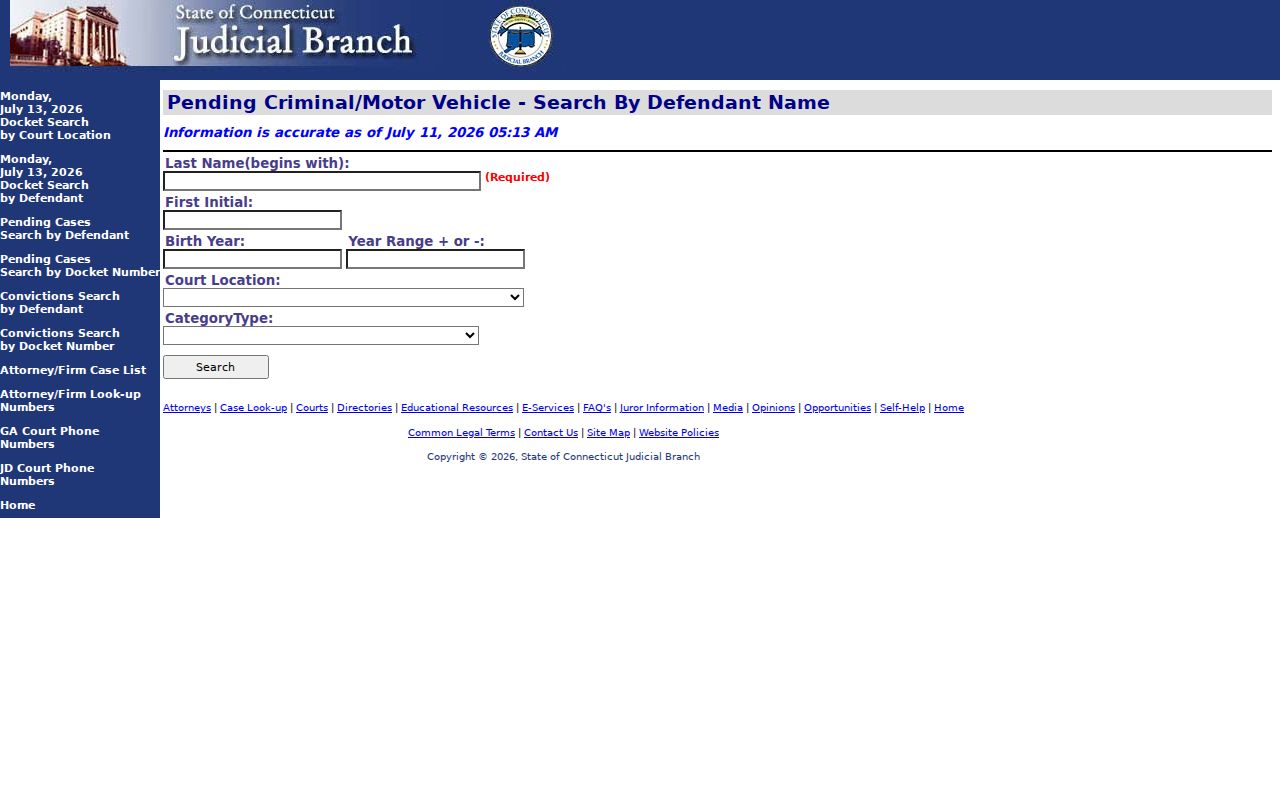
This search can locate open criminal or motor vehicle matters, but it does not replace the official clerk file for certified record use.
Criminal Case Flow
Criminal court records change as the case moves. The first public charge list may not be the final charge list. Motions can affect evidence or release conditions. A plea or trial can resolve one count while another count is dismissed. Sentencing can add jail, probation, fines, restitution, protective orders, license consequences, or other court-ordered terms.
Case flow: Charges Filed › Arraignment › Pretrial / Motions › Plea or Trial › Disposition › Sentencing
| Stage | What Happens |
|---|---|
| Charges filed | The prosecution files or proceeds on formal charges that open the court case. |
| Arraignment | The court addresses the charges, rights, counsel, plea posture, bond, or release conditions. |
| Pretrial / Motions | Parties file requests, negotiate, exchange information, and address legal issues before plea or trial. |
| Plea or Trial | The case resolves by plea, verdict, dismissal, nolle, or other court action. |
| Disposition / Sentencing | The record shows the outcome and any sentence, probation, fine, or other condition. |
What Fairfield Criminal Records Show
Fairfield criminal court records should be read field by field. The docket number ties the record to the clerk file. The court location tells where to verify it. The charge list identifies each count and statute where public. The disposition says what happened to each charge. The sentence field, when available, explains the court's order after conviction or plea.
| Field | What It Shows |
|---|---|
| Docket number | The court identifier used for searches, clerk requests, and case tracking. |
| Defendant | The named person in the criminal or motor vehicle case, often narrowed by birth year in searches. |
| Court location | The venue, such as Bridgeport GA 2 or Bridgeport Judicial District. |
| Charges | Each filed count, charge description, statute reference, and public charge status where available. |
| Plea | The defendant's formal answer or resolution posture for a charge. |
| Disposition | The outcome, such as conviction, dismissal, nolle, not guilty, or bond forfeiture result. |
| Sentence | Jail, probation, fines, release conditions, or other court-ordered terms when public. |
Conviction searches have a separate public route. The manifest image below comes from the criminal and motor vehicle convictions by defendant search.
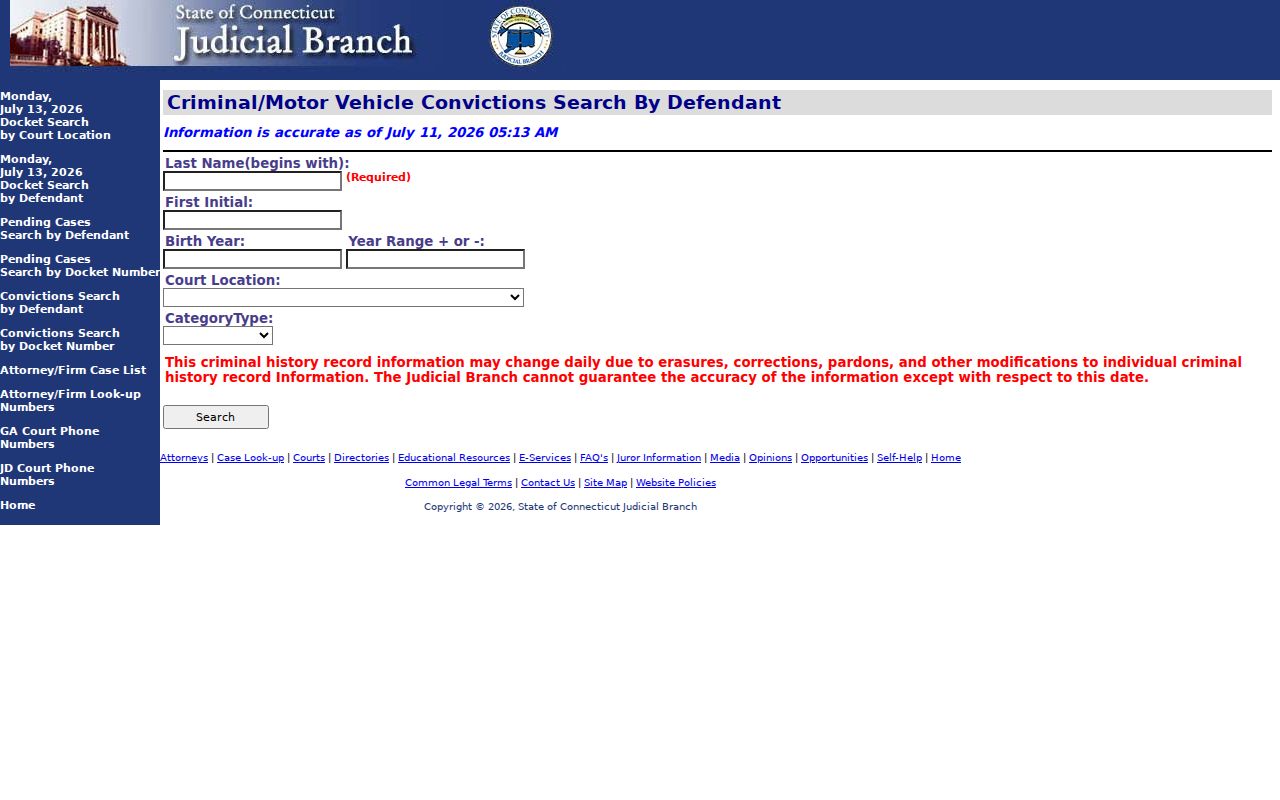
The conviction route is useful for outcomes, while the pending route is better for open Fairfield criminal court records and upcoming events.
Charges vs Convictions
A charge is an accusation filed in court. A conviction is a final guilty outcome by plea, finding, or verdict. A Fairfield criminal court record may show charges that never become convictions. It may also show reduced charges, dismissed charges, nolled charges, or separate outcomes for different counts in one case.
| Charge | Conviction | |
|---|---|---|
| Stage | Filed after arrest or summons when the prosecution proceeds. | Entered after guilty plea, finding, or verdict. |
| Meaning | An allegation that must still be resolved. | A final criminal outcome for that count, subject to appeal or later relief. |
| Search path | Pending case, daily docket, or full court record. | Conviction search and clerk disposition record. |
| Limits | May be amended, reduced, dropped, dismissed, or nolled. | May be erased, pardoned, corrected, or affected by display limits. |
Read Dispositions and Sentences
Disposition is the outcome of a charge or case. In Connecticut criminal court records, common outcomes include conviction, dismissal, not guilty, nolle, or other final court action. A nolle means the prosecutor does not continue the charge at that time. A dismissal ends a charge through court action. A sentence follows a conviction and may include jail, probation, fines, conditions, or other orders.
Conviction information on the Judicial Branch criminal/motor vehicle lookup is generally shown for no more than 10 years after sentencing unless Connecticut Practice Book section 7-13 provides a shorter period. The Judicial Branch also says information is removed one month before the end of that period. Criminal history information can change daily due to erasures, corrections, pardons, and other modifications.
Sealed vs Erased Records
Connecticut uses erasure language for many criminal-record limits. Erased records are generally treated as not disclosable in ordinary public record searches. Sealed records are hidden from public view by court order or law, but they may still exist for limited authorized access. Both terms mean a public Fairfield criminal court search may not show the full history.
| Sealed | Erased | |
|---|---|---|
| Visibility | Not open to the general public. | Generally not disclosed as an existing criminal record. |
| Legal basis | Court order, statute, confidentiality rule, or protected case type. | Conn. Gen. Stat. section 54-142a and related clean-slate or pardon rules. |
| Examples | Juvenile, youthful offender, sealed motions, or sensitive protected records. | Qualifying dismissed, not guilty, nolled, pardoned, or clean-slate eligible records. |
Public Criminal Record Access
Public access to Fairfield criminal court records is controlled by Connecticut court systems, public-record laws, criminal-record statutes, and confidentiality rules. Conn. Gen. Stat. section 54-142a governs erasure for qualifying criminal records. Section 54-142g defines criminal-history record information and public criminal matters in dissemination contexts. Youthful offender records have separate protections under Connecticut law.
Key Statutes:
Conn. Gen. Stat. section 54-142a - qualifying dismissed, not guilty, nolled, pardoned, and certain conviction records are erased and generally not disclosed.
Conn. Gen. Stat. section 54-142g - defines criminal-history record information and public criminal matters for dissemination rules.
Prosecution and Defense Roles
Connecticut uses State's Attorneys, not county district attorneys. The Bridgeport Judicial District State's Attorney office prosecutes criminal offenses for the district, and the Fairfield/Bridgeport Part A office handles more serious cases, including many class A or class B felonies. Public Defender Services has both Fairfield Judicial District and GA 2 offices in Bridgeport for eligible defendants.
Those offices may appear in context around a case, but they do not replace the clerk as the record holder. The prosecutor files or proceeds on charges, defense counsel represents the accused, and the court clerk maintains the case record. For background screening, use legally compliant consumer-reporting channels when the purpose is employment, housing, credit, insurance, or another FCRA-regulated use.
Important: Informational criminal case lookup is not a consumer report and should not be used for FCRA-regulated decisions.
Restricted Fairfield Criminal Records
Juvenile cases, Youthful Offender cases, sealed matters, erased records, active investigative records, protected victim information, sensitive family-violence details, and personal identifiers may be absent from public Fairfield criminal court records. The criminal lookup states that juvenile cases, Youthful Offender cases, and infraction or violation convictions are not shown. It also warns that criminal history information may change daily.
Custody status should be checked separately through Connecticut Department of Correction channels. An inmate result can mean the person is accused and awaiting trial, not necessarily convicted. Active warrants also use a separate Judicial Branch warrant path. A full record review should tie together the court docket, clerk file, prosecutor or defense context, and any separate custody or warrant record.