
Fairfield County Active Warrants
Fairfield County warrant records need careful routing because Connecticut does not operate a county sheriff warrant office for Fairfield. The Town of Fairfield is served by state Superior Court locations in Bridgeport, local police records channels, the Connecticut Department of Emergency Services and Public Protection, and federal agencies for federal matters. The official online starting point is the Connecticut Judicial Branch arrest warrant search, which is linked from the Judicial Branch criminal and motor vehicle lookup menu. That tool is useful, but it is not a complete promise that every warrant is public, current, or visible.
Many Fairfield warrant questions involve Geographical Area 2 at Bridgeport or the Bridgeport/Fairfield Judicial District. A warrant may have been issued after a new criminal allegation, a failure to appear, a violation of probation, or another court order. Some warrants are sealed before service. Others may be cleared after an appearance, bond posting, dismissal, nolle, or other case event. Online data can lag behind court action, so a person who sees a possible Fairfield warrant should verify the docket with the court clerk, counsel, or the police agency before assuming the status is final.
The Connecticut Judicial Branch warrant page is the source shown in the Fairfield County warrant record image below.
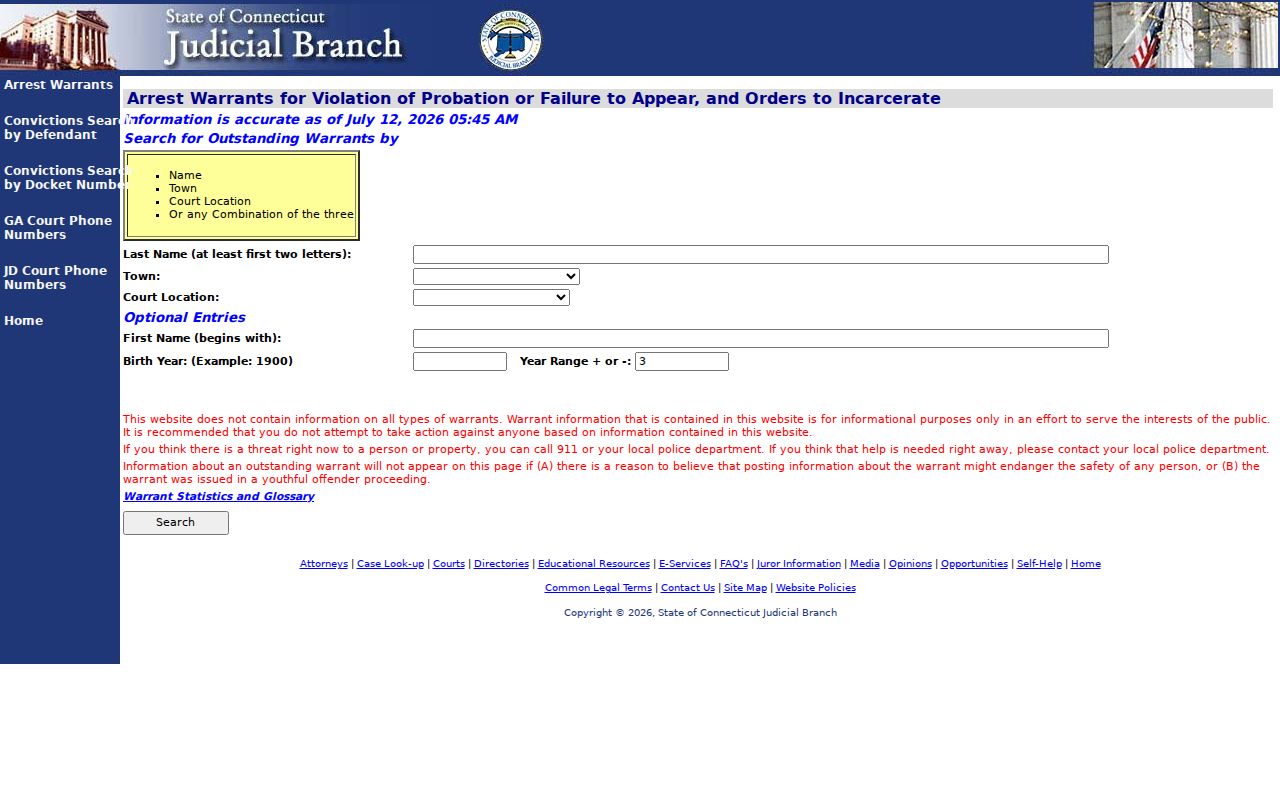
The screen is important because it shows why Fairfield warrant research starts with a state court tool instead of a local county sheriff search.
Fairfield County Warrant Types
A warrant is a court order, but the reason for the order affects where the record may be found and how it should be handled. Fairfield Police may be involved in an arrest. The Superior Court may hold the docket and warrant status. The Department of Correction may show custody after an arrest. Federal agencies may hold a separate warrant when the charge is federal. These paths should not be blended into one county database.
- Arrest warrant - A court order authorizing arrest on a criminal allegation.
- Bench warrant or failure to appear - A court order often tied to a missed hearing or failure to comply with a court command.
- Violation of probation warrant - A warrant tied to alleged breach of probation terms after a prior sentence.
- Capias - A custody order used in some enforcement and court-compliance settings.
- Search warrant - An order allowing a search of a place, device, person, or property, often restricted while an investigation is active.
- Sealed warrant - A warrant that is not public until a court unseals it or it is served.
ICE detainers and federal custody holds require a separate check. Connecticut DOC notes that offenders held on behalf of Federal Immigration and Customs Enforcement are not included in the state inmate database, and federal warrants should be checked through federal court, federal counsel, or the proper federal law-enforcement channel.
How to Search Fairfield County Warrants
Start with the Judicial Branch warrant tool, then use related court and custody channels to confirm the result. A Fairfield warrant search may need more than one query because the warrant record, pending case, daily docket, and custody status are separate data points. If the case is a lower-level criminal or motor vehicle matter, Bridgeport Geographical Area 2 is often the court location. More serious criminal matters may route through the Bridgeport/Fairfield Judicial District.
- Open the Connecticut Judicial Branch arrest warrant search and search the name exactly as it may appear in court records.
- Use the Criminal/Motor Vehicle Case Look-up to check pending cases, convictions, daily dockets, and docket-number paths.
- If a Fairfield case appears, note the court location, docket number, charge basis, and any date or bond information shown.
- Call the proper clerk before appearing in person. GA 2 at Bridgeport lists the Chief Clerk's Office at 203-579-6568.
- For custody after arrest, check the Connecticut DOC inmate search or contact DOC Public Information if the online result is unclear.
- For federal cases, use the U.S. District Court, PACER, U.S. Marshals, or Bureau of Prisons channels instead of state warrant tools.
Note: Daily criminal and motor vehicle dockets may not include add-on dockets, so a same-day court appearance can require clerk confirmation.
Fairfield County Warrant Search Fields
The research file did not identify a Fairfield-only warrant form because no county sheriff system exists. The state warrant and criminal/motor vehicle paths are the practical search channels. The pending criminal and motor vehicle search is especially useful when a warrant question also involves a case status or next court date.
| Field Label | Type | Required | Notes |
|---|---|---|---|
| Last Name (begins with) | Text | Yes for defendant search | Maximum length 60; use the start of the last name as it may appear in court records. |
| First Initial | Text | No | One character; useful for common surnames. |
| Birth Year | Text | No | Four-digit year can narrow a common name. |
| Year Range + or - | Text | No | Single digit used with birth year to widen or narrow the search. |
| Court Location | Dropdown | No | Use Bridgeport Geographical Area 2 or Bridgeport Judicial District when the Fairfield case location is known. |
| CategoryType | Dropdown | No | Criminal, Motor Vehicle, or Referred for MV/Boat License/Reg Suspension. |
What Fairfield Warrant Records Show
Public warrant information is narrower than a full criminal case file. A warrant result may show enough to identify a defendant, the court, and the basis for the warrant, but it may omit sensitive investigation details. A pending criminal or motor vehicle docket may add hearing dates, court location, charges, or disposition information. Police records can add arrest-report context, but those records are subject to Connecticut FOIA limits, law-enforcement exemptions, pending investigation rules, and erasure law.
| Field | What It Shows |
|---|---|
| Defendant name | The person named in the warrant or related court case. |
| Docket or case number | The court identifier used to verify the warrant with the clerk. |
| Court location | The Superior Court site connected to the case, often GA 2 or the Bridgeport Judicial District for Fairfield matters. |
| Charge or violation basis | The alleged offense, probation issue, failure to appear, or other reason for the warrant. |
| Issuing court or judge | The court authority when that detail is public. |
| Bond or release condition | Any bond amount, hold, or release direction shown in the public record. |
| Status warning | Notice that public data may be incomplete, sealed, changed, or not current. |
Resolving a Fairfield County Warrant
Do not ignore a warrant, and do not assume a web result is complete. A Fairfield warrant can lead to arrest during a traffic stop, at home, at work, or at court. The safer path is to confirm the docket, identify the court, and speak with a lawyer before making contact that could cause an immediate arrest. Eligible defendants may contact the GA 2 Public Defender at 203-579-6551 or the Fairfield Judicial District Public Defender at 203-579-6501. Others should contact private counsel.
After counsel reviews the case, the next step is usually clerk confirmation. Ask whether the matter belongs to GA 2 at Bridgeport, the Bridgeport Judicial District, probation, or another court location. Ask whether bond, arraignment, surrender, or a scheduled appearance is required. If surrender is required, arrange the place and time through counsel and the proper law-enforcement or court channel.
Important: A person with an active warrant should get legal advice before appearing at court or contacting police.
Fairfield Police and DESPP Records
Police records are not the same as court warrant records. Fairfield Police may hold an incident report, arrest report, or local investigative record. DESPP and Connecticut State Police sources may hold statewide law-enforcement records. Public access can be limited when disclosure would affect an active investigation, expose protected information, or conflict with erasure and confidentiality rules. Fairfield town FOIA requests apply to existing town records only; the town does not have to create custom research, analysis, or new materials in response to a request.
Use the court search first when the question is whether a warrant or case exists. Use Fairfield Police, DESPP, or a FOIA request when the question is about a police report, local incident, or agency-held record. If a case has already moved into court, the court docket may show public case events while the police report remains partly restricted.
Federal Fairfield Warrant Paths
Some Fairfield-area arrests or investigations are federal. Federal warrants, federal custody, and federal dockets are separate from Connecticut warrant tools. The U.S. Attorney's Office for the District of Connecticut handles federal prosecutions in the state, while federal docket access generally runs through PACER or the U.S. District Court for the District of Connecticut. Federal custody after sentencing is searched through the Bureau of Prisons inmate locator.
The U.S. Attorney source page appears in the Fairfield County warrant research image below.
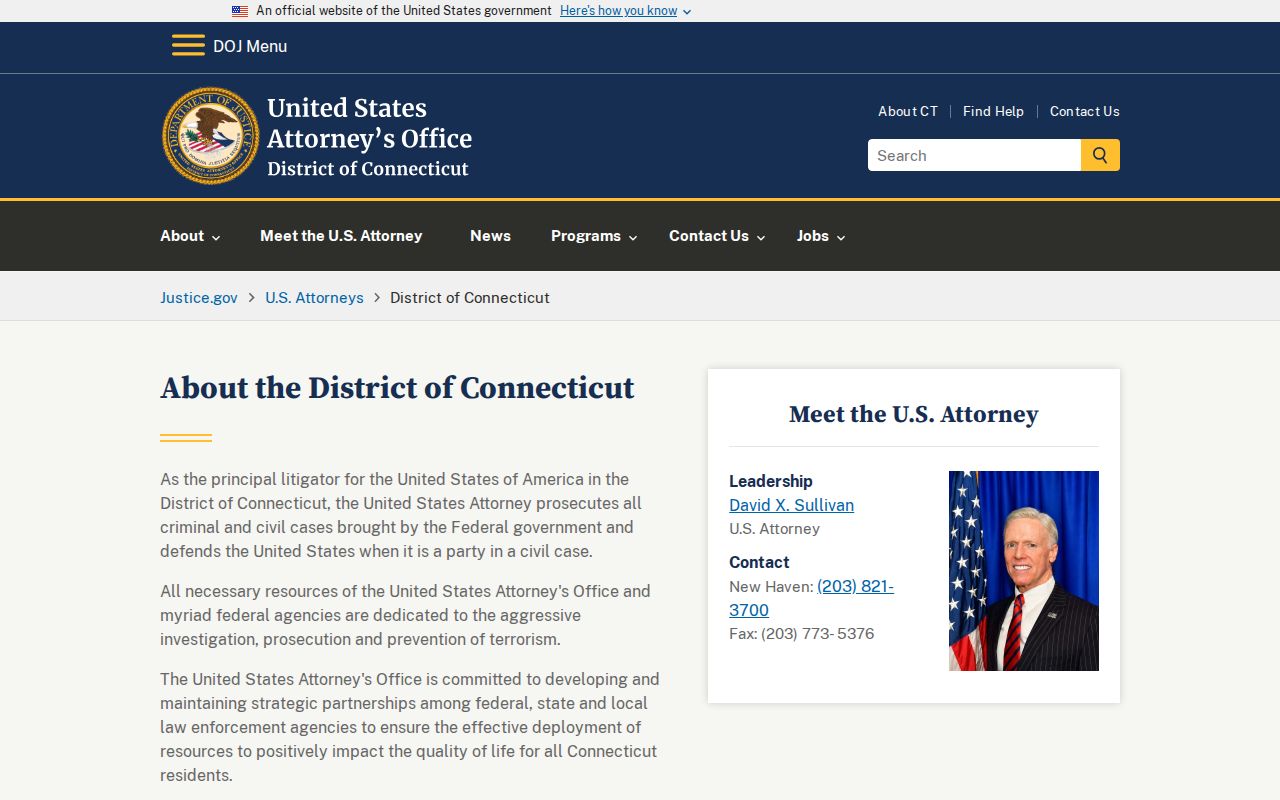
That source belongs on a warrant page because federal prosecution and custody are the right fallback when a Fairfield matter is not in Connecticut state court.
Restricted Fairfield Warrant Records
Not every warrant record is public. Sealed warrants may stay hidden until service or a court order. Search warrants often remain confidential while an investigation is active. Juvenile and youthful offender matters are restricted. Erased criminal records under Connecticut law generally are not disclosed through ordinary public searches. Personal identifiers, protected addresses, witness information, and investigative facts may also be redacted.
Connecticut public-record rules require public agencies to provide existing public records unless an exemption applies, but court confidentiality rules and criminal erasure law can override routine access. For Fairfield warrant records, the practical rule is simple: use public lookup tools for leads, then verify with the court of record or counsel before relying on the result. Court confirmation matters most when the warrant may affect arrest, bond, a driver's license, probation, employment screening, or a custody search.